Tom R. Chambers is a photographer, visual artist, curator and educator with over 100 personal exhibitions worldwide. He has also curated numerous exhibitions in the U.S.A., Zimbabwe, China and India.
He taught photojournalism and fine arts photography ... "The McEwen Photographic Studio" ... for school leavers in Zimbabwe (exhibitions: "Moments In Time/II/III"). Chambers was Visiting Lecturer in Digital/New Media Art and Digital Photography for the Fine Arts Department, Zhaoqing University, Zhaoqing, China. He was invited by the National Institute of Design (NID) in Ahmedabad, India to conduct a three-week, New Media Art and Digital Photography workshop for its new media design graduate students. The workshop culminated in the exhibition, “NMA@NID”.
Chambers was Personal Photographer to the Mayor and City Photographer, Providence, Rhode Island. His coverage is part of the City Hall Archives under the namesake of "The Tom R. Chambers Photo Collection". In 2016, he returned to Providence to mount a retrospective exhibition of his coverage from 1985 to 1990 titled "Retro Providence: 1985-1990" (sponsored by Providence City Archives). He was University Photographer and Manager for the Photo Department, Rhode Island University; and he was Manager for the Photo Department, Texas Tech University Health Sciences Center.
He was invited by the National Gallery of Zimbabwe to exhibit "Variations on the Dan Mask". While in Zimbabwe, he also received a U.S. Government Grant via the United States Information Service (USIS), Harare to exhibit the photo project, “Southwest of Rusape: The Mucharambeyi Connection”. Chambers' tribute piece (photo/mixed media/interactive work), “Mother's 45s” was selected through national search for exhibition as a part of the “Parents” show at the Museum of Contemporary Art, Wright State University, Dayton, Ohio. American Photographer magazine listed one of his documentary projects, “Dyer Street Portraiture” in the Notable Exhibitions section of its March, 1986 issue. His photo documentary project, “Descendants 350” was shown throughout Rhode Island, and accepted by the Secretary of State (Rhode Island) as a part of the Rhode Island State Archives Permanent Collection.
Chambers founded and directed a not-for-profit, photographic arts organization and gallery, “Viewpoint”, Lubbock, Texas (American Photographer magazine reviewed one of the exhibitions at the gallery in its April, 1983 issue). Chambers had the opportunity to collaborate with Choi Ok-soo, a South Korean documentary photographer, by putting together a two-person show, "People to People" for the Kumho Art Center, Gwangju, South Korea. The exhibition photographs are a part of the Kumo Art Foundation Collection.
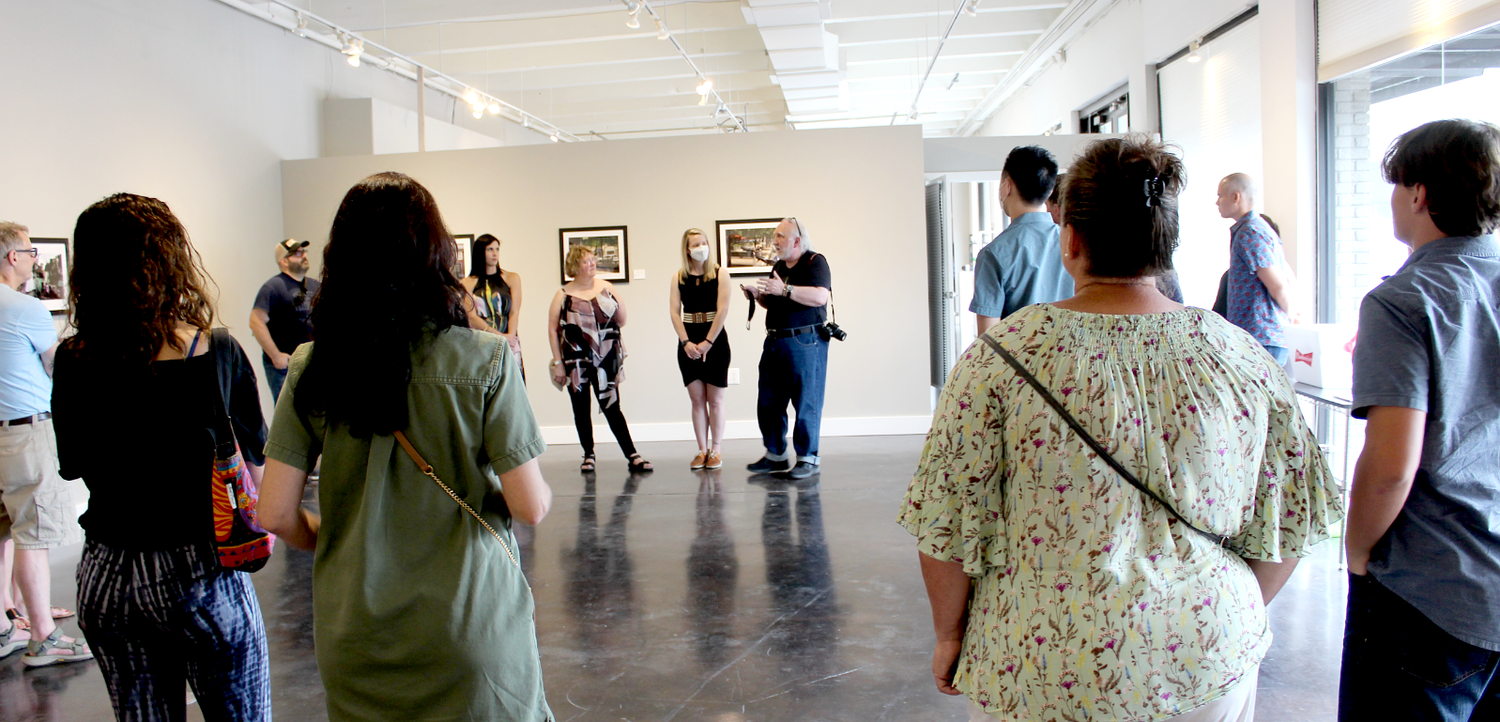
Teacher
Chambers taught two all-day street photography and documentary portraiture workshops at Precision Camera (Education Center), Austin, Texas. He covered the history of street photography, discussed Masters' photographs and his photographs, and discussed the street environment and documentation concepts and strategies. Exhibitions titled, "On the Streets of Austin" were held at Artworks Gallery in the city.
examples


Geometric Abstractionist
Tom R. Chambers is also a Geometric Abstractionist. His work offers a compelling exploration of the enduring power of Geometric Abstraction, skillfully recontextualized within the framework of digital media. He doesn't simply replicate Suprematism; he reinterprets it, breathing new life into the movement's ideals through the lens of modern technology. Drawing heavily on pioneers like Malevich, Chambers successfully translates the language of form, structure, and dynamic composition into the digital arena.
Digital Suprematism
What sets Chambers apart is his thoughtful engagement with the core principles of both historical movements and contemporary digital capabilities. His compositions are not mere digital renderings of Suprematist ideas. Instead, they feel like a conversation between the past and the present, a dialogue about the utopian aspirations of early 20th-century abstraction and their potential resonance in a digitally-mediated world. The bold color palettes and meticulously arranged geometric shapes, so characteristic of his inspiration, are elevated through the clean lines and precise control afforded by digital tools.
The central concept of 'the pixel as geometric abstraction' is particularly insightful. Chambers encourages us to see beyond the pixel's utilitarian function as a building block of digital images. Instead, he proposes that the pixel *itself* can be viewed as a fundamental geometric form, a square or rectangle ripe with potential for artistic expression. This reframing allows for a deeper understanding of how digital media can be used to explore core abstract principles.
Overall, Tom R. Chambers' work is a thought-provoking and visually striking exploration of the intersection between art and technology. He successfully bridges the gap between historical movements and contemporary media, offering a fresh perspective on the enduring relevance of geometric abstraction in our increasingly digital culture. His art prompts us to reconsider the boundaries of artistic expression and to find new meaning in the fundamental building blocks of our digital world.
The following DSGA (Digital Suprematism - Geometric Abstraction) artworks are more than just a visual experience; they are an interactive conversation between historic inspiration and contemporary execution.
They offer a compelling dialogue between art historical reverence and modern digital manipulation, resulting in an engaging and thought-provoking experience. The pieces transcend simple visual appreciation, inviting viewers into an interactive conversation about artistic lineage and the evolution of form.
The core concept – extracting pixel configurations from digitized reproductions of Kazimir Malevich's pre-Suprematist works – is inherently intriguing. By magnifying and isolating these early elements, the artist unearths geometric abstractions hidden within the source material, effectively highlighting the seeds of Malevich's later revolutionary vision. Framing these 'Pixelscapes' as a celebration of Malevich's 'latent and ultimate creativity' provides a persuasive narrative, connecting the pieces to the pivotal moment when Suprematism emerged.
The large-scale presentation of these pixel configurations is particularly effective. Not only does it amplify the visual impact, but it also strategically evokes a range of key art historical movements. Suprematism, Geometric Abstraction, Minimalism, and Color-field are all subtly referenced, encouraging viewers to consider the works within this broader artistic context.
Moreover, the inherent quadrilateral formatting of the pixel structures lends itself to compelling geometric arrangements. The resulting grids, planes, and juxtapositions of color create a dynamic visual landscape that actively engages the viewer's perception. The 'in situ' color scheme, derived directly from the source images, adds a layer of authenticity and organic connection to the original artwork.
Ultimately, DSGA's artworks succeed in their ambition to stimulate a visceral response. They are not simply recreations or reproductions; they are reinterpretations, recontextualizations, and, perhaps most importantly, they encourage viewers to actively participate in the ongoing conversation about art, history, and the transformative power of digital media. They are a worthy tribute to Malevich's legacy and a relevant contribution to contemporary abstract art.